
Prof. Lin-Tai Da's team from Shanghai Center for Systems Biomedicine at Shanghai Jiao Tong University, together with collaborators has developed a groundbreaking multimodal deep learning framework that predicts DNA-binding interfaces and residue-level base preferences for DNA-binding proteins (DBPs). The study, titled “Prediction of Residue-Level Base Preference for DNA-Binding Proteins Using a Multimodal Learning Framework,” was recently published in the prestigious journal JACS Au.
Specific recognition between proteins and DNA governs fundamental biological processes, including transcriptional regulation and the maintenance of genomic integrity. Although structural data for DNA-binding proteins (DBPs) have expanded rapidly, high-throughput experimental characterization of their binding specificities remains a major bottleneck. Existing computational approaches often rely on pre-existing DNA structural context, which can introduce conformational bias, or struggle to generalize across diverse protein families, computationally modeled structures, and unbound proteins that undergo substantial conformational rearrangements upon binding.
To address these limitations, the research team developed 3M-BSIP (3-modal base-specific interaction predictor), an end-to-end framework that operates directly on protein representations without requiring prior DNA structural information. It constructs a comprehensive DBP feature representation by integrating three distinct modalities: evolutionary conservation from a protein language model, internal spatial relationships from a geometric graph neural network, and molecular surface geometry from a hierarchical point-cloud encoder. Coupled with a cross-attention fusion mechanism, 3M-BSIP learns general biophysical principles of DNA recognition, achieving high accuracy in interface residue identification, contact strength ranking, and base preference prediction. Notably, the model maintains robust performance on structures predicted by AlphaFold3 and unbound apo-protein structures.
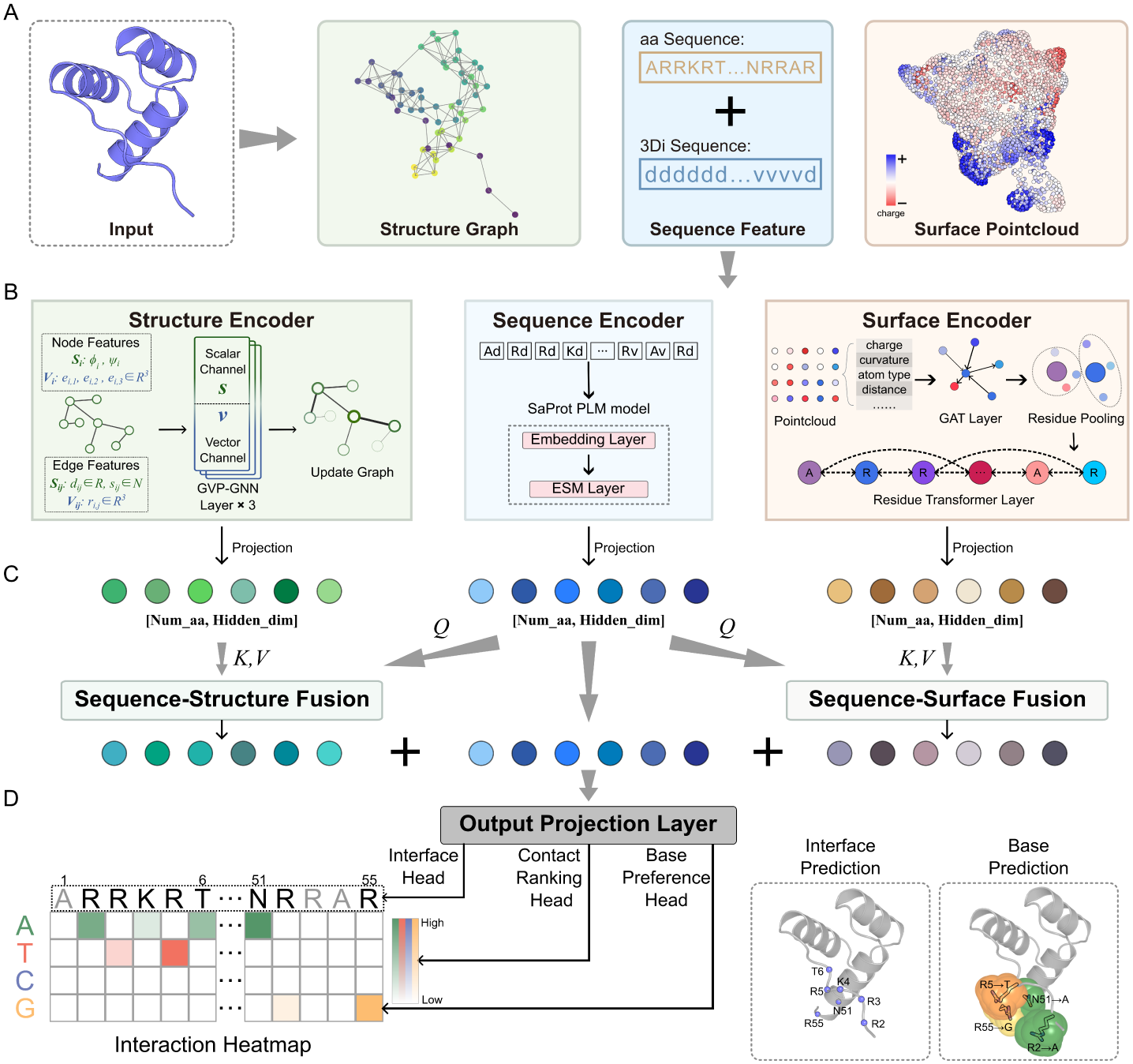
The researchers validated 3M-BSIP across two practical applications. In motif discovery for uncharacterized proteins, the framework predicted the target binding motif and critical interface residues for a novel bacterial transcription factor from Streptomyces, with predictions confirmed by electrophoretic mobility shift assays and cellular reporter experiments. In protein engineering, 3M-BSIP guided the redesign of the Type IIB restriction endonuclease BsaXI. By combining deep learning predictions with energy-based scoring, the engineered variants successfully altered target base preference from G:C to A:T and T:A, as verified by surface plasmon resonance assays.
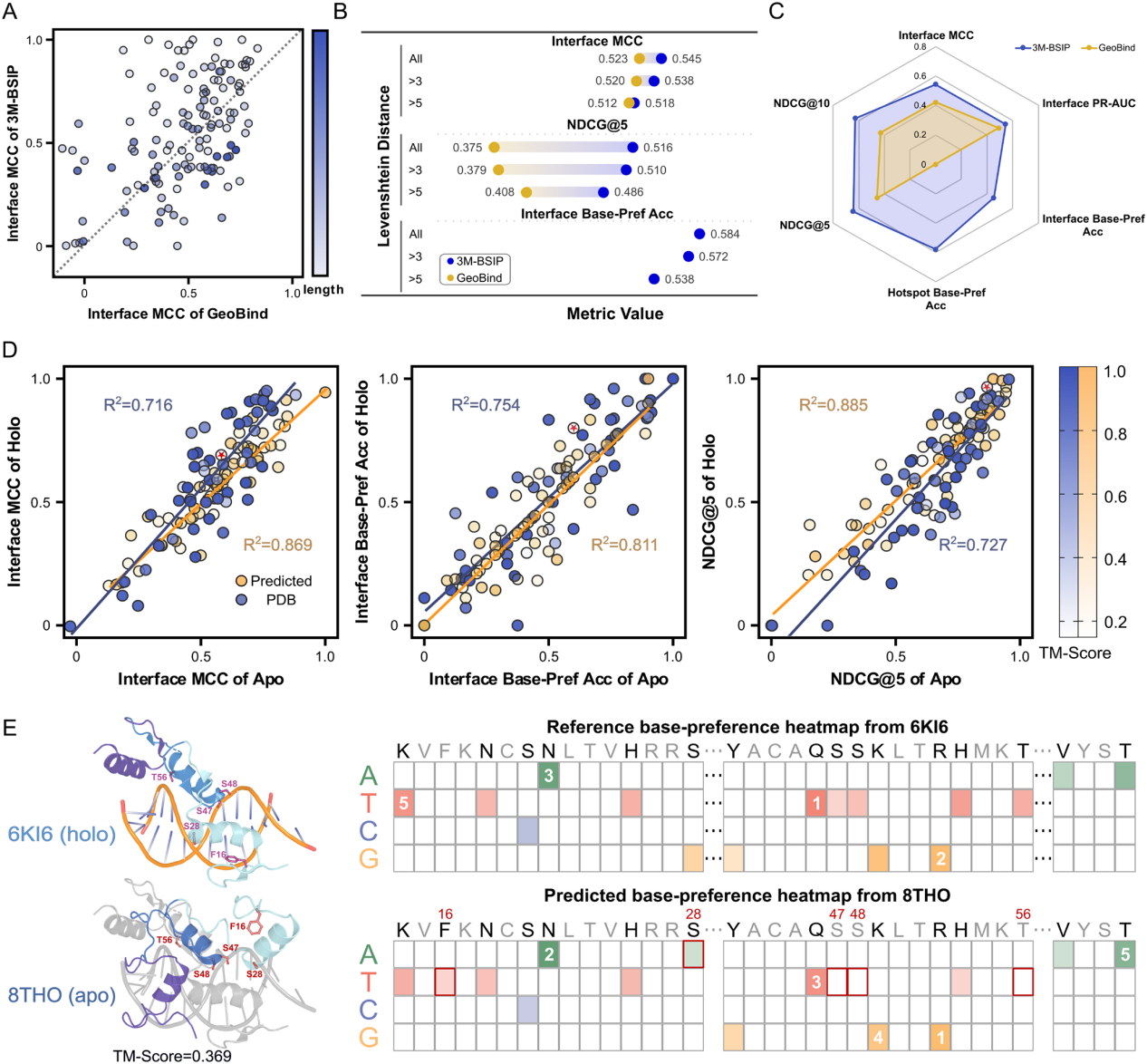
This multimodal deep learning framework provides a scalable approach for high-throughput functional annotation of DBPs and offers a rational strategy for designing custom DNA-binding proteins in synthetic biology and genome editing applications.
Prof. Lin-Tai Da from Shanghai Center for Systems Biomedicine and Prof. Yong Zhang from the School of Life Sciences and Biotechnology at Shanghai Jiao Tong University serve as co-corresponding authors of this article. Siyuan Li (PhD student) and Wenyan He (PhD student) from Prof. Lin-Tai Da’s team are the co-first authors. This work was supported by the National Natural Science Foundation of China, the Natural Science Foundation of Shanghai, and the National Key Research and Development Program of China.
Full text available at: https://doi.org/10.1021/jacsau.6c00925

Address:800 Dongchuan Road, Shangha
Fax:200240
Tel:021-34206059